20/10/2026
THE FEARLESS ORGANIZATION – Amy C. Edmondson
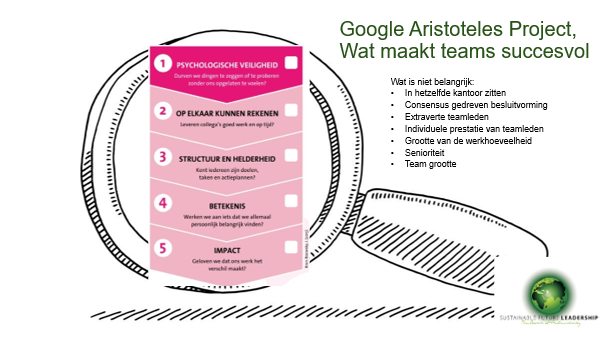
Google did a study, called Aristotle Project, into what makes teams successful.
What did Google's Project Aristotle prove about team effectiveness?
Google analyzed hundreds of teams and found that the composition of a team — intelligence, experience, skills — is not the deciding factor. The strongest predictor of team performance turned out to be psychological safety: the extent to which team members feel safe to take risks, identify mistakes and share ideas without fear of negative consequences.
According to Google's Aristotle project, psychological safety is the most important precondition for a successful team.
They were very surprised about that themselves. The Californian company was looking for the most important components of a good team and had analyzed huge data packages for this.
Which combination of competencies is the most successful, how many introverts do you put against extroverts, how much diversity is needed, you name it, they would have researched it. But it didn't yield anything. There was no distinctive combination of any variable that could predict a team's success.
Until they stumbled upon psychological safety by chance. When team members feel safe to be vulnerable and they trust their colleagues, the team functions best. And not one team, all teams. Behind it are things like clear roles, goals and structures.
In fact, everything about safe culture has been reduced to psychological safety, clarity and honesty. To organizational culture, in other words.
Why is this so important for teams? Everything is about people's growth mindset! How can employees grow, by growing in a safe environment between teammates!
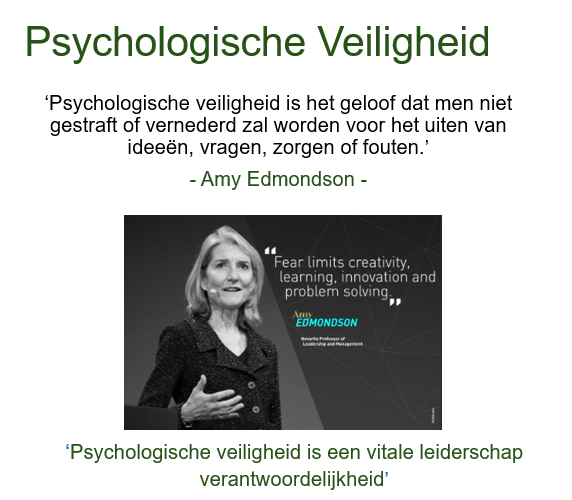
Amy Edmondson is the management guru in the field of psychological safety. In her book 'the fearless organisation', she explains that psychological safety is a vital leadership responsibility.
Psychological safety is the shared belief within a team that it's safe to take interpersonal risks — such as expressing a different opinion, admitting a mistake, or asking an uncomfortable question — without fear of humiliation or rejection. The concept was scientifically introduced in the 1990s by Amy Edmondson, professor at Harvard Business School, and has since been widely recognized as one of the strongest predictors of team performance.
Psychological safety is emphatically not a cuddle culture or the avoidance of tension. It is quite the opposite: a climate in which honesty, contradiction and learning from mistakes are possible because people feel safe enough to be vulnerable.
Psychological safety is the belief that one will not be punished or humiliated for expressing ideas, questions, concerns or mistakes, according to Amy Edmonson, a very inspiring lady who is truly the founder of this.
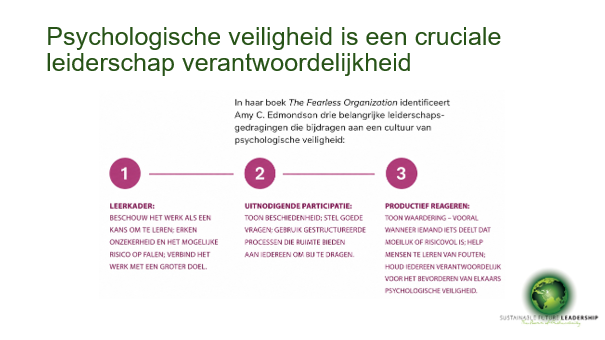
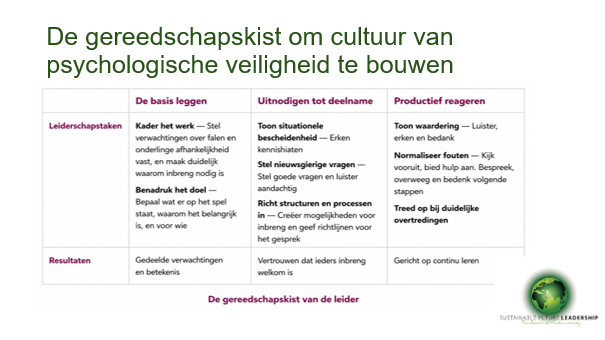
Creating a learning framework for the work:
This is an important leadership responsibility to create the framework in which employees can learn, but also what goal we are working towards. It's in small things, right in the details and wording too. For example, instead of 'investigating a mistake', a company can phrase it into a 'study of a malfunction or accident', with this subtle but important approach you try to make people think differently about work and especially about what it means when something goes wrong with a focus on safety, how is that portrayed in the organization. As a manager, you create a framework for the work. We all form an automatic framework (a frame of mind) for situations. Our attention as humans is focused on a situation itself and we usually have a blind spot for the effects of our own framework. Previous experiences affect how we think about and feel about what is going on in a situation right now. We are convinced that we see reality. For example, in this example: by not assuming that someone makes a mistake in an accident (possibly due to incompetence), but we can change our automatic frameworks into a common framework that more accurately reflects reality: for example, complexity in the system creates risks and possible accidents. It's really in wording and perception.
As a manager, inviting participation, out of genuine curiosity, is in my opinion the most important behavior to create a culture of psychological safety. With sincere, curious and sometimes direct questions, and above all respectful and concrete, makes people think. By being genuinely curious and connecting with people, people will feel invited to participate and give their input where improvements lie and will also be willing to contribute together to improve things. Genuine curiosity is the core.
Responding productively is about how you as a manager deal with when employees speak out, the invitation to participate builds psychological safety, but if the manager or HR manager reacts with anger, nonchalance or in the worst case contemptuously, safety will quickly disappear. A productive response should be appreciative, respectful, and pave the way for progress.
These 3 behaviors are important to use as a leader to create a culture of psychological safety, leadership is crucial in this. But the role of HR is also crucial in guiding leaders and all managers in these behaviors and creating this culture. And in addition, to show the exemplary behavior in this, but also to create the preconditions so that leaders can get started. Check for yourself what is already there in your company in these 3 areas, how is this implemented in your organization and in what way can much more attention be paid here. What is needed for this? What is already there and can help with this and how do you connect with what is already there and what is still needed to each other, so that it becomes a coherent program that will reinforce each other?
These are all questions that you as an HR professional, but also as a leader/manager have to live through in order to give them the right attention. It is not a one-time action, but a continuous process, in which you have to have faith as an organization and as a person and always give attention and direction.
The most important skill (as a supervisor and HR manager) is to master is to be able to create a framework for the work. To satisfy employees, managers must be able to provide the right framework for the work. This demands a lot from a manager, as indicated above, but it is important to provide structure, to become concrete and to connect well with the practice of the employees: to give guidelines, but also expectations on how to deal with deviations and to emphasize interdependence. Let employees know that they need to understand that their tasks affect the tasks of others. This interdependence stimulates frequent conversations in terms of the impact of work on each other, which makes communication necessary. Roles and responsibilities must be clear, otherwise employees cannot take those responsibilities. It sounds logical, but in practice this is often quite difficult.
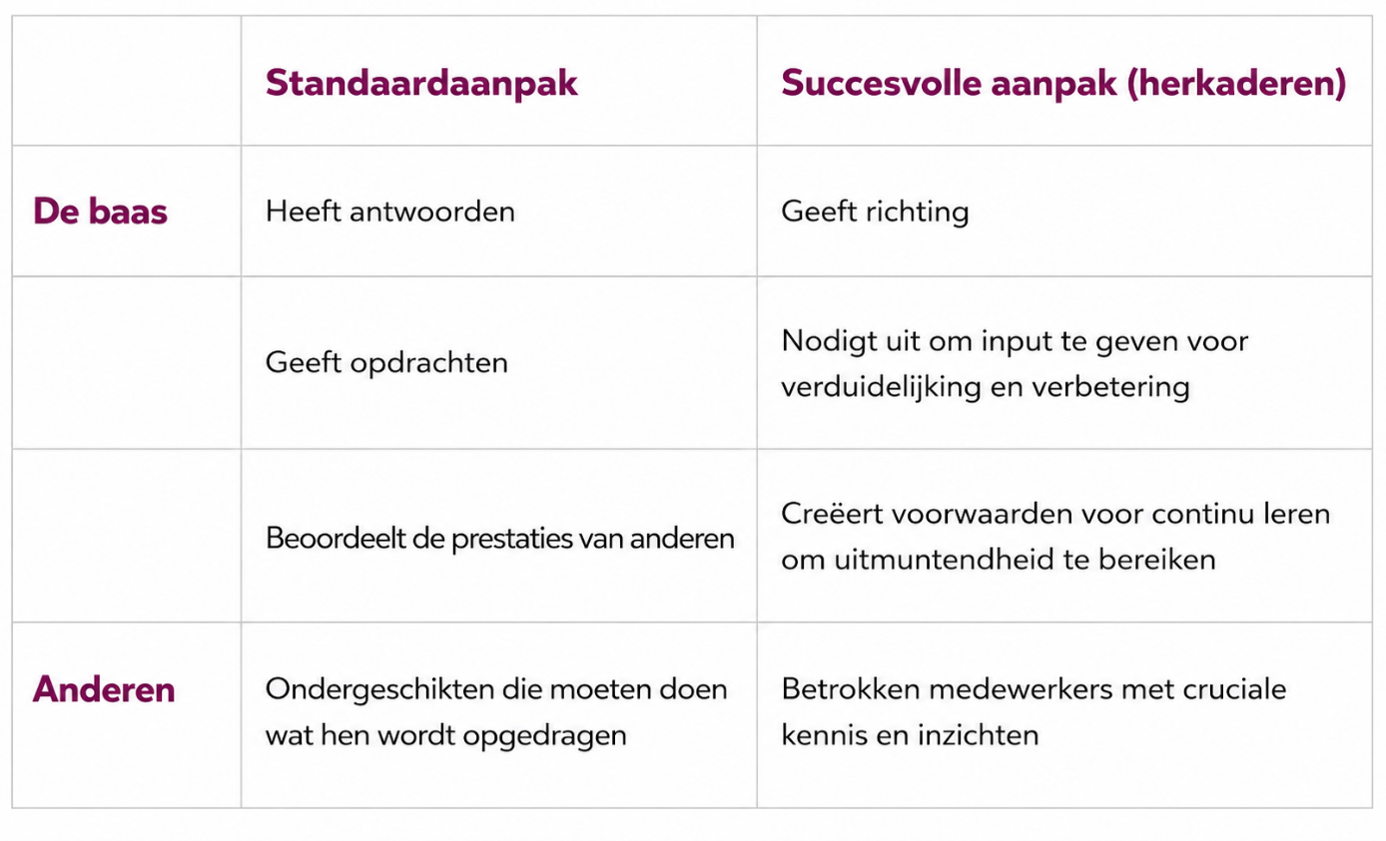
How most employees see their 'bosses' is also important when creating a new framework.
As a manager, you will therefore consciously show different wording when reframing and actually show different behavior (also at times and perhaps especially at the moments when things get tense)
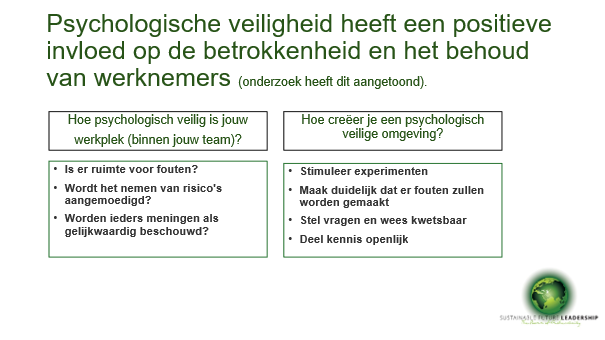
It is important to create a culture of psychological safety in the workplace.
The 3rd leadership responsibility around creating a culture of psychological safety is how to respond productively to what is being said.
• Show appreciation – listen, acknowledge and thank.
• Sometimes give a summary in the words of the other person uses, so that it gives the other person even more insight and also invites them to explore further, but also show that you have understood what has been said (gives recognition with that)
• These are also coaching skills
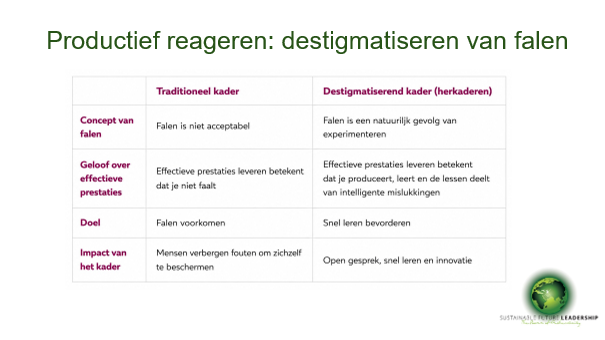
But above all, it is also important to remove any stigma from 'failure'.
Failure is a necessary part of uncertainty and innovation, but this must be made explicit to strengthen the invitation to speak.
See the table on how to also reframe the stigma surrounding failure.
Managers who react in the same (not positive) way to failures will not create a healthy environment for a learning process. When a mistake occurs because someone violates a rule or a norm that is important to the organization, it is very different from when a well-considered hypothesis in an innovation project turns out to be something. It seems obvious, but practice often shows otherwise.
Actually promoting the learning process is about making mistakes is allowed, but not using it as an excuse.
However, punish clear violations.
In short, psychological safety is enhanced rather than harmed by a just, deliberate response to potential danger, harmful, or careless behavior.
The book 'The Fearless Organization' by Amy C. Edmonson elaborates on the models mentioned above and the book is highly recommended for anyone who wants to create a culture of psychological safety in his/her organization!